



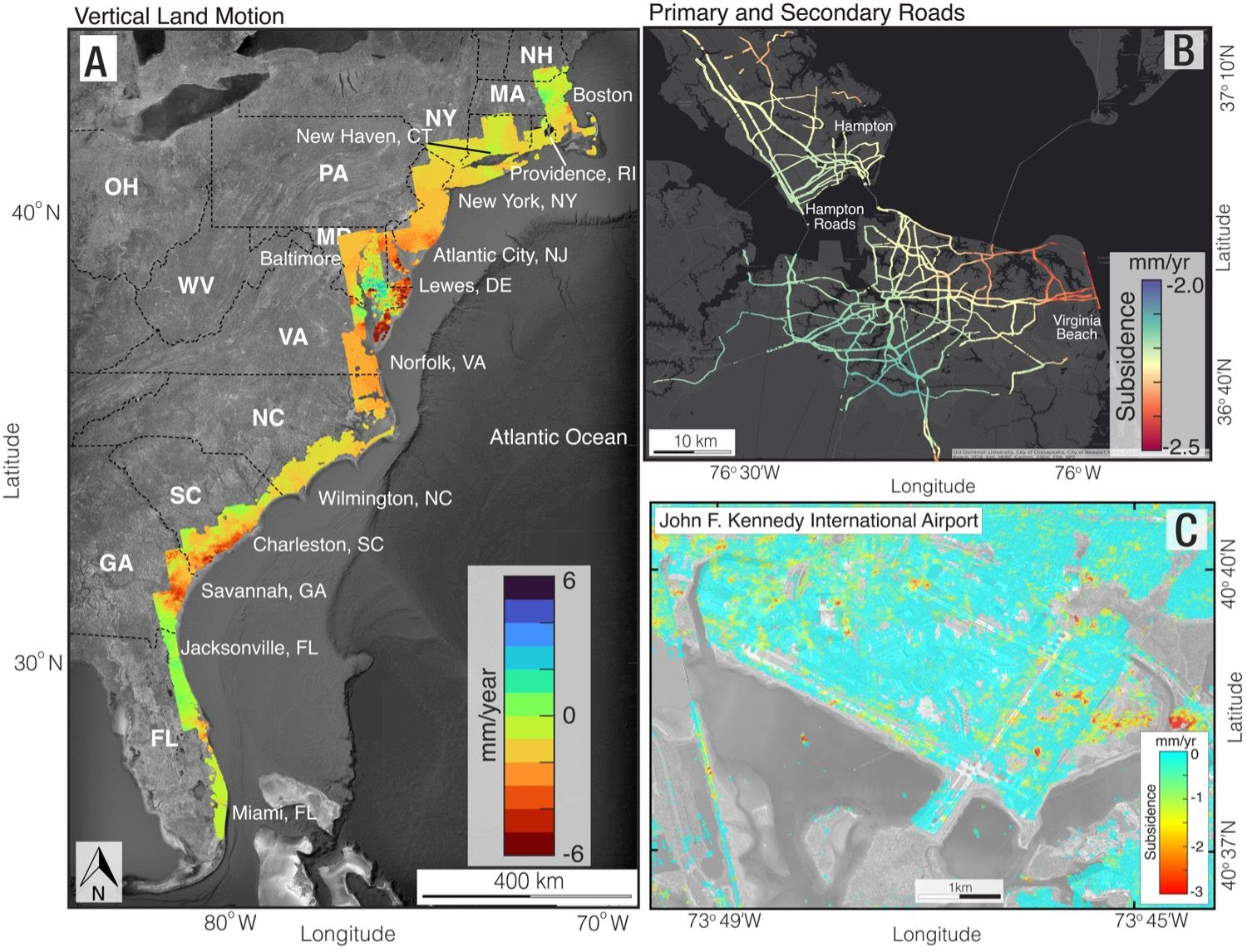
Major cities on the U.S. Atlantic coast are sinking, in some cases as much as five millimeters per year – a decline at the ocean’s edge that well outpaces global sea level rise, confirms new research from Virginia Tech and the U.S. Geological Survey.
Particularly hard-hit population centers such as New York City and Long Island, Baltimore, and Virginia Beach and Norfolk are seeing areas of rapid “subsidence,” or sinking land, alongside more slowly sinking or relatively stable ground, increasing the risk to roadways, runways, building foundations, rail lines, and pipelines, according to a study published today in the Proceedings of the National Academies of Sciences.
“Continuous unmitigated subsidence on the U.S. East Coast should cause concern,” said lead author Leonard Ohenhen, a graduate student working with Associate Professor Manoochehr Shirzaei at Virginia Tech’s Earth Observation and Innovation Lab. “This is particularly in areas with a high population and property density and a historical complacency toward infrastructure maintenance.”
Shirzaei and his research team pulled together a vast collection of data points measured by space-based radar satellites and used this highly accurate information to build digital terrain maps that show exactly where sinking landscapes present risks to the health of vital infrastructure. Using the publicly available satellite imagery, Shirzaei and Ohenhen measured millions of occurrences of land subsidence spanning multiple years. They then created some of the world’s first high resolution depictions of the land subsidence.
These groundbreaking new maps show that a large area of the East Coast is sinking at least 2 mm per year, with several areas along the mid-Atlantic coast of up to 3,700 square kilometers, or more than 1,400 square miles, sinking more than 5 mm per year, more than the current 4 mm per year global rate of sea level rise.
“We measured subsidence rates of 2 mm per year affecting more than 2 million people and 800,000 properties on the East Coast,” Shirzaei said. “We know to some extent that the land is sinking. Through this study, we highlight that sinking of the land is not an intangible threat. It affects you and I and everyone, it may be gradual, but the impacts are real.”
In several cities along the East Coast, multiple critical infrastructures such as roads, railways, airports, and levees are affected by differing subsidence rates.
“Here, the problem is not just that the land is sinking. The problem is that the hotspots of sinking land intersect directly with population and infrastructure hubs,” said Ohenhen. “For example, significant areas of critical infrastructure in New York, including JFK and LaGuardia airports and its runways, along with the railway systems, are affected by subsidence rates exceeding 2 mm per year. The effects of these right now and into the future are potential damage to infrastructure and increased flood risks.”
The new findings appear in the open access journal PNAS Nexus. In the work “Slowly but surely: Exposure of communities and infrastructure to subsidence on the US east coast,” Virginia Tech and U.S. Geological Survey (USGS) scientists measured how much the land along the East Coast has sunk and which areas, populations, and critical infrastructure within 100 km of the coast are at risk of land subsidence. Subsidence can undermine building foundations; damage roads, gas, and water lines; cause building collapse; and exacerbate coastal flooding – especially when paired with sea level rise caused by climate change.
“This information is needed. No one else is providing it,” said Patrick Barnard, a research geologist with the USGS and co-author of the study. “Shirzaei and his Virginia Tech team stepped into that niche with his technical expertise and is providing something extremely valuable.”
Virginia Tech

