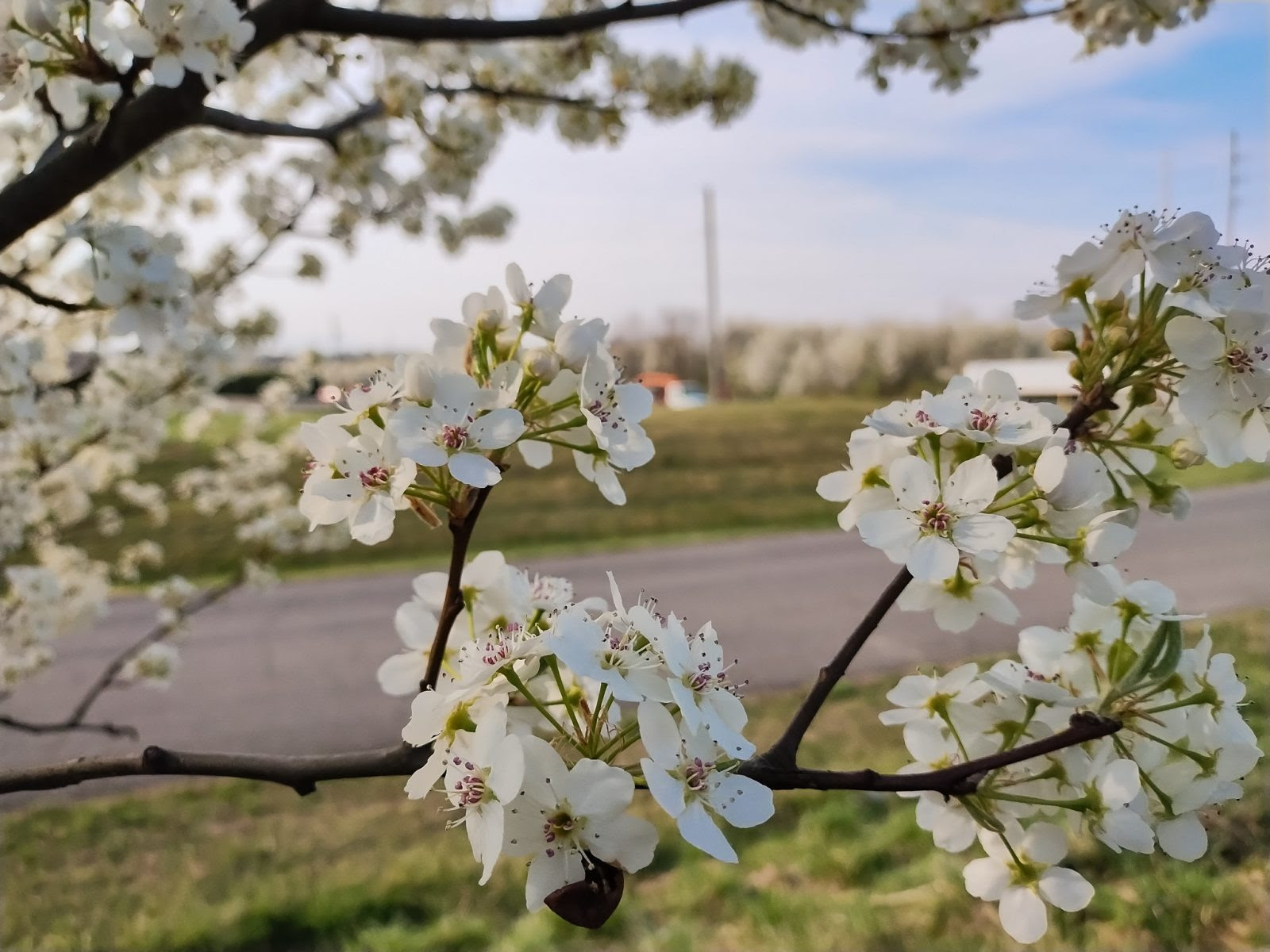
You’ve probably seen the beautiful white flowers of Callery pear trees, more commonly known as Bradford pear trees, that are blooming now throughout the commonwealth.
You might have caught a whiff of their pungent fishy aroma. You might also have noticed that there are a lot more of these trees than there used to be.
Callery pear trees are beautiful, but they are one of the worst invasive species in the Southeast. That is because the Callery pear is an invasive species — one of the worst in the Southeast — and it’s rapidly spreading from Virginia’s urban landscapes to disturbed areas such as roadsides and even into forests.
“In areas without active vegetation control, such as roadsides and road interchanges, you see a proliferation of Callery pear. There are some areas along roads that are now 100 percent Callery pear trees,” said Eric Wiseman, associate professor of urban forestry and arboriculture and Virginia Cooperative Extension specialist in the College of Natural Resources and Environment.
“They are also very hard to control. If you cut the stem back at ground level, it will still grow from the root, so all you’ve done is cut the plant back, not kill it,” he said.
The Virginia Department of Forestry now offers an exchange program through which landowners can remove a Callery pear and receive a native tree replacement. Learn more about the exchange program.
Pear trees have widely used as ornamental landscape trees since the 1970s. The trees were initially seen as cost-effective, fast-growing, and easy-to-establish additions to the suburban landscape.
Unfortunately, pear trees produce fertile seeds that are readily spread by birds. These wild-growing seedlings are tolerant of harsh growing conditions and thrive in poor soil, which means they can pop up practically anywhere. These seedlings also inherit the genetics of their uncultivated ancestors, developing undesirable characteristics such as sharp thorns.
What makes a species invasive?
Non-native species become invasive when they escape control and begin to cause harm to natural resources, economic activity, or humans.
Callery pears spread easily and can form dense thickets. These thickets leaf out early and outcompete native plant species growing around them, reducing biodiversity. The sharp thorns that grow on wild-growing Callery pear seedlings make them difficult — and painful — to manage.
Native plant biodiversity provides food and habitat for animals and insects, including native bee species, and contributes to the overall health of Virginia’s natural communities.
Wiseman said “nonnative” does not necessarily mean “invasive,” and some “nonnative” tree species make fine replacements, though he does recommend planting native species when possible.
A few native alternatives to Bradford or other Callery pear cultivars include the following:
Flowering dogwood, Cornus florida
Serviceberry, Amelanchier spp.
Green hawthorn, Crataegus viridis
Chokecherry, Prunus virginiana
White fringe tree, Chionanthus virginicus
A few nonnative alternatives to Bradford or other Callery pear cultivars:
Katsuratree, Cercidiphyllum japonicum
Paperbark maple, Acer griseum
Japanese snowbell, Styrax japonicum
Smoketree, Cotinus coggygria
More information on woody plants in the landscape is available in the Virginia Cooperative Extension publication Selecting Plants for Virginia Landscapes: Showy Flowering Shrubs.
Interested in learning more about gardening? Virginia Cooperative Extension Master Gardeners bring the resources of Virginia’s land-grant universities – Virginia Tech and Virginia State University – to the people of the commonwealth. Contact your local Master Gardeners through your Extension office or learn more about gardening in Virginia and the Virginia Extension Master Gardener program.
Tom Soladay for Virginia Tech