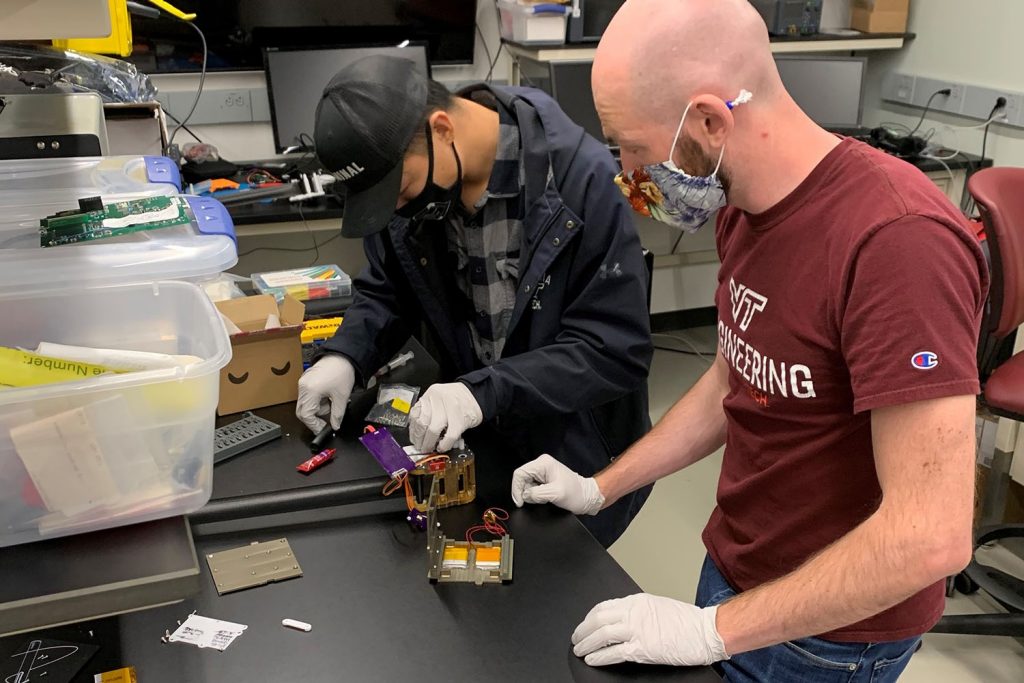
Few students have the opportunity to design, test and build a satellite and see it successfully launched into space. A group of Virginia Tech engineering students is one step closer as their satellite, the “ThickSat,” has been delivered for space launch qualification testing before being integrated onto the rocket for launch.
What began as a conceptual senior capstone design project for a group of aerospace engineering seniors two years ago has since been expanded and developed into a complex piece of hardware bound for low-Earth orbit. Once cleared for flight, the completed satellite will fulfill its mission when it launches into space aboard the Cygnus NG-15 spacecraft, scheduled for launch in February 2021.
“This project is providing students at both the undergraduate and graduate levels the unique opportunity to design, develop, test and monitor their own experimental payload and see it successfully launched into space,” said Jonathan Black, professor in aerospace and ocean engineering, co-director for the Center for Space Science and Engineering Research (Space@VT), and director of the Aerospace and Ocean Systems Lab at the Hume Center at Virginia Tech. “Throughout the process, they are gaining critical skills in spacecraft systems engineering and space science that will complement what they are learning in the classroom.”
Humble beginnings
At Space@VT, Virginia Tech’s ThickSat was developed by a large team of undergraduate and graduate students from across the College of Engineering and the College of Science over the past two years.
Professor Kevin Shinpaugh encouraged student participation in the ThinSat program as part of his space vehicle design course, a year-long senior capstone design experience in the Department of Aerospace and Ocean Engineering.
According to Shinpaugh, the plan was to design a satellite during the first semester, complete a quick build and test with a low-altitude balloon flight prior to delivering the final space flight payload in the spring. The undergraduates designed and built a prototype, but delays in the test phase occurred, and as the seniors graduated and departed Virginia Tech, a group of Space@VT students picked up the project where they left off.
Virginia Tech’s completed flight unit was recently delivered to the Near Space Launch in Upland, Ind., where it will undergo space launch qualification testing to ensure the hardware can withstand launch and deployment in the space environment. The ThickSat, along with dozens of ThinSat projects from other university and high school teams, will then be integrated into a satellite dispenser and prepared for launch. The payloads will be transported back to the NASA Wallops Flight Facility and attached onto the upper stage booster on the Cygnus NG-15 and launched into space.
After the Cygnus spacecraft separates from the rocket, the satellite dispenser will open up and disperse the satellites at the edge of the Earth’s atmosphere, in the region known as extreme low Earth orbit. The satellites will collect data or perform their intended missions for about five to seven days before burning upon re-entry into Earth’s atmosphere.
Since the ThickSat project’s inception, approximately 25 Virginia Tech undergraduate and graduate students have had a hand in this mission as part of a much larger cross-institutional team. Students from aerospace engineering, mechanical engineering, electrical and computer engineering, computer science and physics have worked together to make the mission a reality.
— Written by Jama Green